
Know Your Type: Dear Design-Forward Collector, The Room Is Not the Point
This is the second post in my Know Your Type series on the four collector types I’ve identified through years of advisory work. If you missed the first one on the Venturist collector, start there.
There is a moment I have watched happen like it’s Groundhog Day — and it tells me immediately that I’m looking at a Design-Forward Collector. They walk into a gallery or a fair booth, stop in front of a work, and before they’ve spent more than ten seconds with it, they say — sometimes out loud, sometimes just with their body — “I don’t know where I’d put that.”
That’s the Design-Forward Collector. And before I say anything else, I want to say this clearly: there is absolutely nothing wrong with wanting art that looks good in your home. I have said it before and I will keep saying it. It’s okay for the art to match the couch, or not match the couch, whichever way your interior design swings. The art world has spent decades making people feel lesser for caring about how a work looks in their living room, and I think that’s one of the most damaging things it has done to its own future.
So this is not a post about why you should stop caring about how your art collection lives in your interior design schema.
It’s a post about what you might be doing before you even get to the walls.
The Design-Forward Collector has genuine skills that more intellectually driven collectors often lack. They think spatially. They curate instinctively — mixing media, varying scale, understanding that a room full of paintings on canvas is not very interesting. They are drawn to beauty and coherence and what I’d call a spatial story: the way objects in a room speak to each other, create tension, and establish a mood. Some of the most considered collections I’ve ever seen belong to Design-Forward Collectors. They understand that art lives in the world, not in a white cube, and that the experience of living with work every day is as important as the experience of encountering it for the first time.
They are also the ones who often approach an art fair with their Pinterest board in hand, trying to match a specific spatial vision with what is available to buy right now.
They are often the collectors the art world looks down on most. And I want to acknowledge something uncomfortable here: I have contributed to that problem.
Like most advisors who work on beautiful projects, I post the beautiful projects. The stunning living rooms, the carefully considered installations, the spaces where art and architecture and interior design have come together in a way that makes you want to sit down and never leave. I post these because they’re beautiful and because the algorithm rewards them and because, honestly, they’re what a lot of people want to see. But what I’m inadvertently doing — what we’re all inadvertently doing — is creating a visual culture that tells new collectors this is what collecting looks like. And so they go out into the world trying to replicate an image they saw on Instagram rather than trying to understand what they actually respond to.
It’s a vicious cycle and I’m part of it. I’m naming that because I think it’s worth naming.
Here’s what the Design-Forward Collector does brilliantly: they bring taste and intention to the spatial experience of living with art. These three artists are in The Collection for exactly that reason — they reward the Design-Forward eye while also checking the harder boxes.
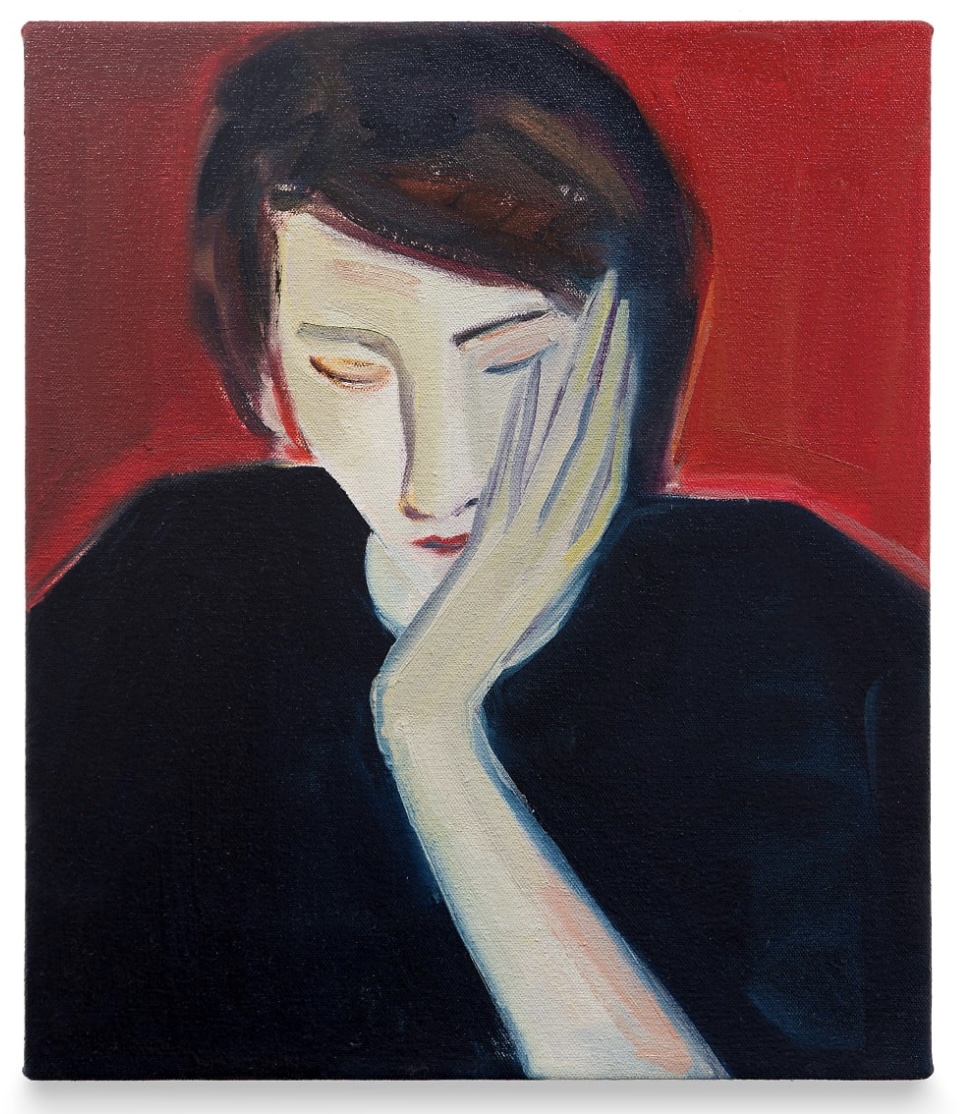
Eve Ackroyd’s The Evening Before — a figure withdrawn against a field of deep red, painted with subtle psychological intensity — works for them because it has a clear emotional temperature that anchors a room without dominating it. The color story is strong but livable, the scale is considered, and there’s a melancholy in it that deepens over time.
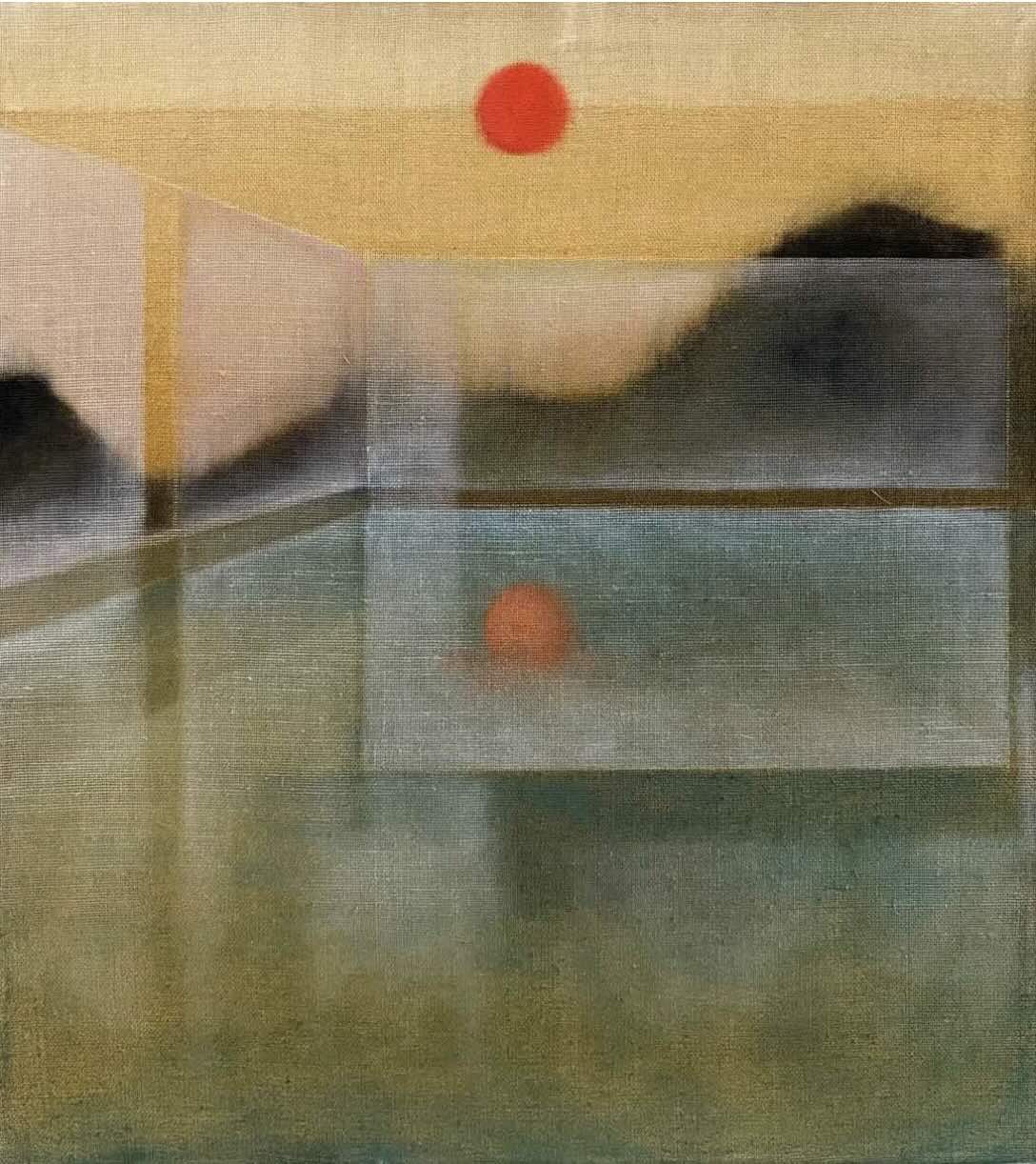
Kristen Giorgi’s Mirror Field works for them because it’s atmospheric and geometric at once, soft and structured in equal measure, and the color palette is just bright enough to bring warmth to a room but not overly saturated or saccharine. It is the kind of painting that changes depending on the light and the hour, which makes it endlessly livable.
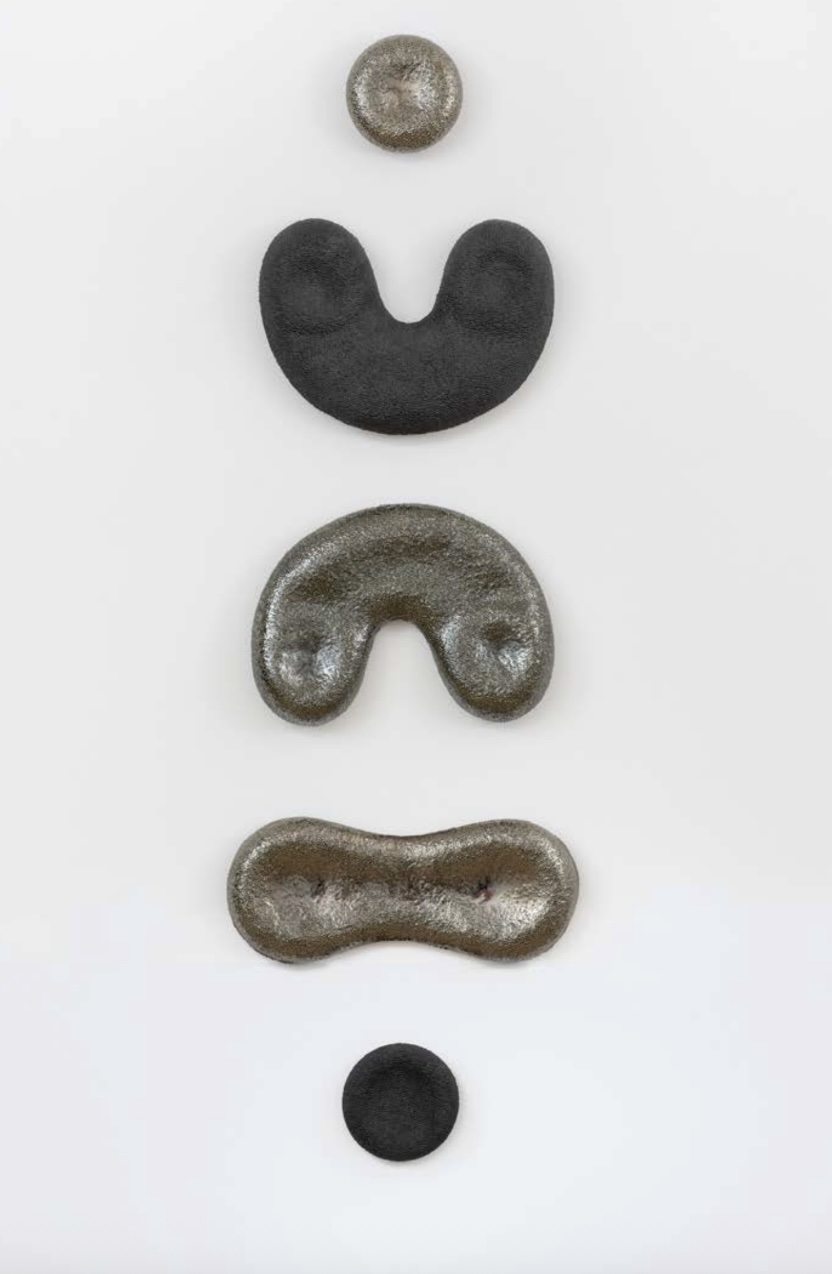
Lana Kova’s Totem III works for them because it breaks the tyranny of the rectangular painting — organic, textural, wall-mounted forms that create rhythm and shadow in a way that a flat canvas never could.
These are not compromises. These are genuinely strong works that also happen to live beautifully. That’s not a lower bar. That’s a harder one.
But here’s what the Design-Forward Collector sometimes does before any of this: they edit.
They look at a work and decide — in seconds, before the work has had a chance to speak — that it doesn’t go anywhere. That it’s too much, too difficult, too something. And in doing so they eliminate entire categories of experience from their consideration before taste even enters the equation.
Take Vaughn Davis Jr.’s sculptural paintings. Canvas and cardboard torn, painted, and cascading off the wall onto the floor in colors that are simultaneously beautiful and aggressive. A Design-Forward Collector looks at this and thinks: where would that even go? And I understand that response. It refuses to be contained. It won’t stay flat. It demands not just wall space but floor space and airspace and a certain willingness to let the work be uncomfortable in the room.
But what they’re walking past is a work that is asking something profound about the human process of becoming and unbecoming — the way we as people change and morph and become our truest selves with everything that happens to us. Living with that question every day changes how you think about everything you’ve hung on every other wall. That’s not a decoration. That’s a conversation partner.
Or consider Heekyoung Jeon, whose luminous blue and green landscape paintings a Design-Forward Collector might dismiss as too saturated, too exuberant, too much. And here’s where it gets interesting — because that’s not a spatial judgment. That’s an aesthetic one. They’re not saying it won’t fit the room. They’re saying it won’t fit their idea of what good taste looks like. Which means they are capable of making that distinction. They just apply it inconsistently: they’ll accept quiet decorative work without interrogating it, and reject loud challenging work without interrogating that either.
What Jeon’s paintings actually are is joyful in a way that takes genuine artistic confidence to pull off. The exuberance is not naivety. It’s a position. And a collector who has trained themselves to distrust joy in painting because the art world has taught them that serious art is restrained art is a collector who has let someone else’s taste override their own.
Here’s the thing about the Design-Forward Collector that I want to leave you with.
The room is not the point. The room is the context. And there is a difference.
The best collections I’ve seen in beautifully designed homes are not the ones where every work was chosen to complement the space. They’re the ones where the space was slowly, sometimes reluctantly, organized around the works. Where a collector fell in love with something that didn’t go anywhere and then figured out how to make it go somewhere. Where the art shaped the room rather than the room shaping the art.
That’s a different way of collecting. It starts not with the wall but with the work. Not with “where would I put this” but with “what is this doing to me.” And once you start asking that second question — even as a Design-Forward Collector, even knowing that you care deeply about how your home looks and feels — you find that the works you end up with are both more beautiful and more meaningful than anything you would have chosen by starting with the room.
It’s okay to want art that looks good in your house. It’s okay to want art that tells your personal story. In this case, you can have your cake and eat it too.
Every collector has a type.
A default way of engaging with art — and a default reason they walk away from something they should have bought. Find out yours in two minutes.
Take the Quiz →Already a member? This week's new additions to The Collection are waiting.
Explore The Collection →