
When Is the Last Time You Bought Something That Will Outlast You?
Like something that was specifically designed to last a lifetime and beyond?
We hear it a lot. “They just don’t make things like they used to.” The maxim feels truer today than it ever has before. Cars, washing machines, clothes — nothing is made to last anymore. Everything is fast, made for an ever-changing and evolving world, and largely disposable despite price tags that might suggest otherwise.
And yet we keep spending. On things that will be out of style in three years, worn out in five, forgotten in ten. Most of us have never stopped to ask: is there anything I could buy right now that would actually outlast me? That would still mean something in twenty years — not because it held its value on a spreadsheet, but because it kept giving something back?
I’ve been thinking about this question a lot lately, particularly as someone who spends most of her waking hours thinking about how to buy art that lasts. We live in a culture of extraordinary consumption and almost no permanence. We spend freely on things designed to be replaced — clothes that go out of style, furniture that follows trends, art that matches the sofa. None of it is wrong exactly. But none of it lasts either.
And yet there is a category of object that was specifically designed to outlast its moment. The object is made by someone trying to say something true about their time, their experience, or their way of seeing the world. It is something that leaves its mark on the world by, in the words of art critic Jerry Saltz, “expanding consciousness, deepening experience, and destabilizing certainty.”
That object is a work of art. A real one.
I want to be careful here because I’m not talking about all art. I’m not even talking about expensive art. If you want to know how to buy art that lasts, the distinction I’m making has nothing to do with price and everything to do with intention — the difference between something made to decorate and something made to endure.
Here’s the most honest way I know to explain it.
There is work being made right now — and sold, in galleries, for thousands of dollars — that will look exactly the same in ten years as it does today. You’ll walk past it on your wall and feel the same pleasant feeling you felt the first day. You might marvel at the artist’s unique material or process or reminisce over a particularly lovely vacation to your favorite beach. It will still be pretty. It will still work with the room. And that’s all it will ever do.
And there is other work being made right now — sometimes by artists no one has heard of, sometimes for less money than you’d expect — that will look different in ten years, not because the work changed but because you did. You went through something, or lost something, or became someone slightly different than the person who hung it, and the work has enough in it to meet you where you are now rather than where you were then.
That second kind of work is what I think of when I think about art that lasts.
When you’re buying original art for the first time, the question of what lasts versus what doesn’t is rarely part of the conversation anyone has with you. Most advice stops at “buy what you love.” That’s true — but it doesn’t help you understand what you’re actually choosing between.
Consider Jude Griebel. He is a Canadian sculptor — a 2026 Guggenheim Fellow — who spends months hand-carving miniature figures from wood, clay, textiles, and papier-mâché, merging human bodies with landscapes, consumed species, and the wreckage of the natural world. His sculptures are simultaneously grotesque and tender, darkly funny and genuinely heartbreaking. They are about what we are doing to the planet and to each other — about consumption, erasure, and the strange entanglement between human bodies and the living world around them.
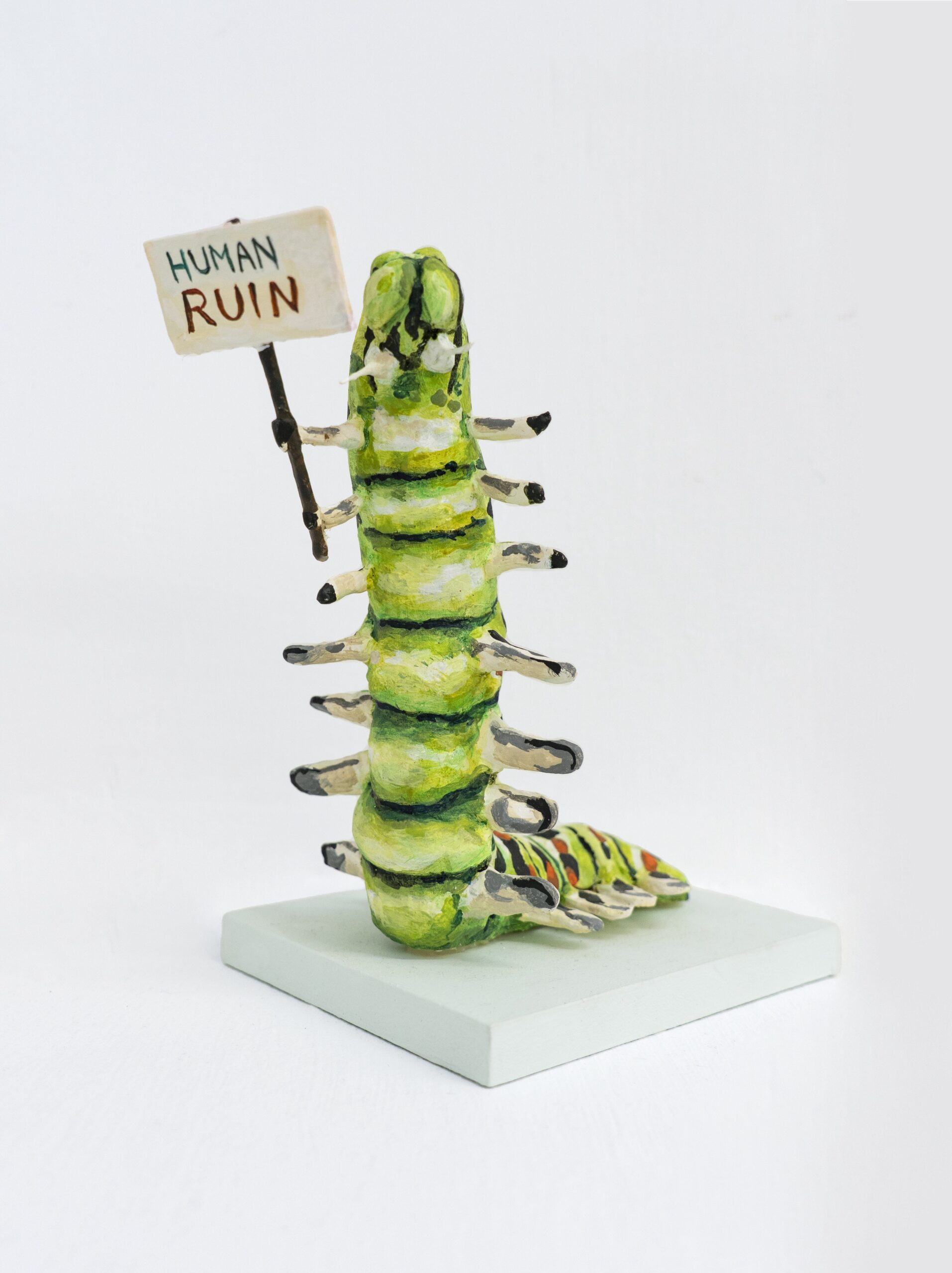
Right now, looking at a Griebel sculpture, you might feel the climate anxiety you carry quietly every day given a form you can actually look at. In five years, as the world changes in ways we can’t predict, the work will mean something different. In ten years, if you’ve had children or lost someone or watched a landscape you love disappear, it will mean something different again. The work has enough in it to grow with you because it is built from something real — a question Griebel cannot stop asking, expressed through a practice of almost incomprehensible patience and craft.
That is what it means to own something that lasts.
The question worth asking before you buy anything — not instead of asking whether you love it, but alongside it — is whether the work has enough in it to grow with you. Whether the artist was making choices or just making something pleasant. Whether there is an intention underneath the surface that will reward you for looking harder as the years go by.
So how do you tell the difference before you buy? That’s exactly what I’m going to spend the next four weeks unpacking.
I’ve developed a framework — four criteria I apply to every work I evaluate, whether I’m walking an art fair, advising a client, or adding something to The Collection. Intentionality. Novelty. Self-awareness. Relevancy. Not art world jargon — practical questions you can ask standing in front of anything, at any price point, in any gallery or fair or Instagram feed. Questions that will help you tell the difference between something made to please and something made to last.
Next week we start with intentionality. It’s probably the easiest one to recognize and appreciate if you are new to art.
This is not an argument against beauty. I believe in beauty. Some of the most lasting works I know are also breathtaking to look at. But beauty that is only beauty — that has no argument underneath it, no question it is asking, no reason it had to look exactly this way and no other way — is decoration. And decoration, however lovely, does not outlast you. It outlasts its moment, maybe. It does not outlast its trend.
The artists I think about in this context are the ones building practices around something real. A question they can’t stop asking. A material that means something beyond its surface. A way of seeing the world that you can’t get anywhere else. When you live with that kind of work, it keeps showing you things. It grows as you grow. It earns its place on the wall not once, when you buy it, but over and over, every time you walk past it and it stops you again.
That is what it means to buy something that lasts.
You don’t have to. Nobody is telling you that you owe the future a collection of significant work. But I think most of us spend so much of our lives buying things that will be forgotten — by us, by everyone — that we forget it’s possible to do otherwise. That for roughly the same money you might spend on something that will be out of style in five years, you could own something that will still be asking you questions in twenty.
When is the last time you bought something that will outlast you?
Maybe it’s time.
Every collector has a type.
A default way of engaging with art — and a default reason they walk away from something they should have bought. Find out yours in two minutes.
Take the Quiz →Already a member? This week's new additions to The Collection are waiting.
Explore The Collection →