
The Veteran Collector’s Secret to Owning Art by the Masters and Prints are Not Posters
It's easier than you think.
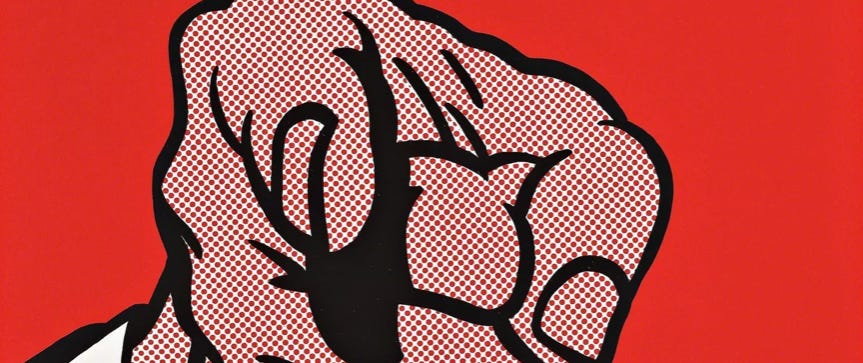
Have you ever wondered how a semi-regular ol’ Joe has a Lichtenstein hanging in his living room or a Matisse in her master bedroom or a Katz in the kitchen or a Banksy in the bathroom? Friends, they are called prints. And no, they are not posters.
Many of the greatest painters from Rembrandt to Ruscha made fine art prints alongside their painting practice. A fine art print, in contrast to a poster, is a reproducible image made in a limited edition. A lot of collectors just call them prints or editions or multiples. To make it a little confusing, because we are art people after all, the term edition also refers to the number of prints struck from a single plate. So if you go to Phillips’ website, for example, you will see a category called “Editions.” This refers to the works the auction house sells that are not unique. Some houses call their print departments “Prints and Multiples.” They all mean the same thing.
I get so many questions about prints and print collecting, so I’m going to do a little FAQ:
Q: How is a print different than a poster?
A: A poster does not have a set edition number. It can and usually is produced in an unknown quantity, it is probably not using high quality or archival materials, and often the artist has nothing to do with its design or production. A poster is temporary and a print is made to last. Artists have been making prints since forever, like the Han Dynasty in China, and the reasons for printmaking have remained largely unchanged. Printmaking is a relatively fast and inexpensive way to more widely disseminate information, images, and text.
Q: Why would I want to buy a print? There are dozens of copies of it.
A: If a big time artist really resonates with you, owning a print by that artist may be the only way you will ever be able to acquire a work by that person. Take Rembrandt. Rembrandt was a PROLIFIC printmaker. Alexander Hamilton : writing :: Rembrandt : printmaking. I think we all know that there are very few Rembrandt paintings still held in private hands. Translation: Almost all of his paintings are in museums. But Rembrandt prints hit the auction block every single season. Some people only collect Rembrandt prints. The catalogue raisonné of his work is vast and the quality of the objects themselves varies significantly. But if you love Rembrandt and only have a few hundred bucks to spend, you could acquire a print made by the master’s own hand. It may not be unique but it surely demonstrates the artist’s process, technical prowess, experimental spirit, and artists genius.
However, when it comes to contemporary printmaking, someone might acquire a print rather than original, unique work because maybe the artist has a really long waiting list or the price of a unique work has already skyrocketed beyond their budget or they are really drawn to this particular medium or art form.
Q: What is a monoprint and a monotype?
A: They sound synonymous but they are not. A monoprint is when an artist uses the same plate or block to produce the same image but makes changes to the final print either directly on the plate between each impression or to the printed image itself. Here is an example of a series of monoprints called Point Reyes by Guimi You. The printed image is the same and then she went back in and hand-finished each one with acrylic overpaint. This is an edition of 25, but here are just 2 examples. I love Guimi’s work but her paintings are usually very large and they have gotten quite expensive. I bought one of these wonderful monoprints instead!


Dream of growing up by Benedict Sheuer demonstrates why it is sometimes difficult to discern monotype versus monoprint. You can see that the images are largely the same but the colors are different and the compositions have some variation. Were they struck from the same plate?Who knows…and honestly who cares. He made 4 monoprints in this series. I own one and a client owns the other and I LOVE it!


A monotype is an image made using printmaking techniques but is totally a one-off, like Cleveland-based artist Corrie Slawson’s work. She is the consummate printmaker and her technique is off the charts, but all of her images are totally unique. A monotype is usually considered a unique work rather than an edition but I imagine there have been heated discussions in some very erudite circles on this topic.

In the image above, Corrie has layered printmaking technique over acrylic painting, spray paint, stenciling, all sorts of media to create this finished work on paper. Is it a painting? Yes. Is it a print? You could probably argue as much. Check out more of her work here.
Q: Ok, cool, but how do I buy a Warhol? And why are the prices all over the board?
A: The short answer is at auction. Decide on the image you like and want to acquire and then watch the auctions for one to come up. You could also buy them from print dealers but the print dealers probably bought them at auction so you might as well go straight to the source. Prices vary based on rarity, condition and desirability. Obviously, low editions make a particular print more rare. Condition refers to the state or quality of the object. Does it have creases or tears or light damage? And of course desirability is how many other people want to acquire this same image. Some prints are more iconic than others and thus, more expensive. You know willing seller, willing buyer, and all that jazz. If you don’t know how to buy at auction or want to better understand the print market for major, iconic artists, feel free to drop a comment below or send me a message.
That feels like enough info for you to digest at the moment.
Key takeaways:
Buying prints is a fantastic way to quickly and easily build your art collection and add some variation to your collection. If you look around at great design, you will likely observe that variation is the key. When every single piece of art is a painting on canvas, it gets boring. Framed prints (almost always behind glass or plexi) change it up a bit. I always like to put prints in high traffic areas where I want art but do not want that unintentional shoulder bump against my unprotected painting or in a child’s room where an errant ball might hit the art.
As always, thanks for being here and for reading what I have to say. Your support means more than you know!