
Know Your Type: Dear Contextual Collector, The Story Is Not Enough
This is the fourth and final post in my Know Your Type series on the four collector types I’ve identified through years of advisory work. If you missed the first three — the Venturist, the Design-Forward Collector, and the Strategic Collector — start there.
I should tell you upfront: I am a Contextual Collector.
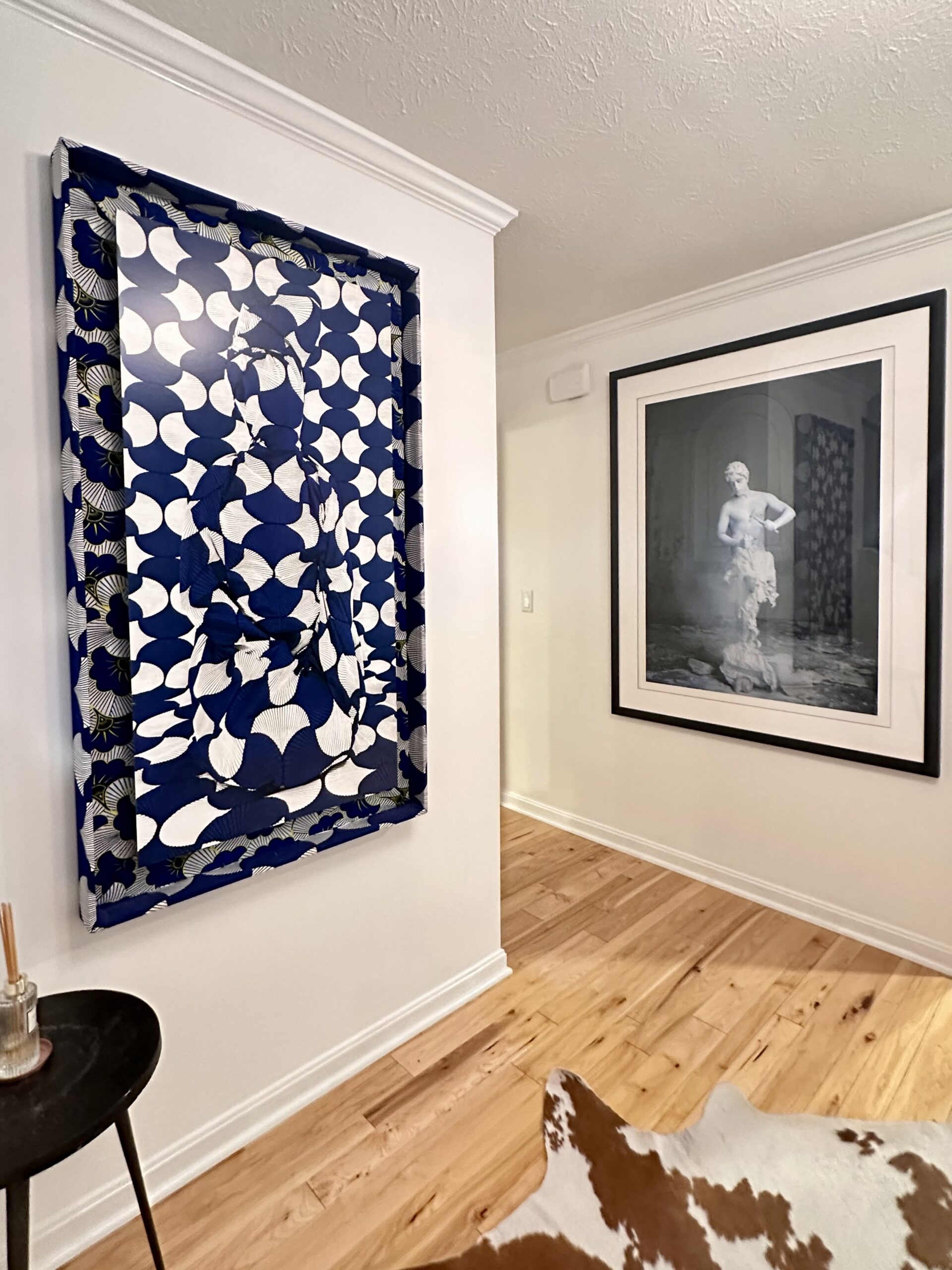
None of my art matches my decor. None of it really matches anything. My walls are not a mood board and they are not a color story. They are a conversation — a series of arguments and agreements between works that have nothing to do with my sofa and everything to do with what I think about the world. I bought every piece because it had something to say and I wanted to live inside that conversation. (Except for 1! 1 piece was gifted to me by the artist because I loved it so much in his studio. And I still find it breathtaking but I always struggle with it because I worry it is too pretty…more on that in a second!)
That is the Contextual Collector in a nutshell. And I want to spend some time with this type because I think it is the most misunderstood of the four, and because understanding its blind spot requires me to be honest about my own.
The Contextual Collector wants to know the story. Not the market story or the spatial story, but the real story, the message: what is this artist trying to say, where does this work come from, what ideas is it in conversation with, and why does it look exactly the way it does? They may or may not care whether it matches the couch. They may or may not care about the artist’s education and CV, although if that context illuminates what the work is doing then it matters enormously. What they care about above all else is the narrative — the intellectual and emotional architecture behind the object on the wall.
The Contextual Collector is also the collector most likely to explain every work in their home to every person who walks through the door. And I mean every work. In detail. With backstory. This is not showing off. It comes from a deep and genuine passion, from the belief that if they can just get you to understand what this work is doing, you will love it as much as they do. The collection tells their story. They want you to read it. (If you’ve noticed, the tag line for Casey Monda Art Advisory is “Transforming spaces into stories.” I think that just about sums it up.)
I recognize myself in this description entirely.
The Contextual Collector collects with genuine intellectual rigor. When they fall in love with a work it is because they have followed the thread of an idea into the practice of an artist and found something that illuminates a question they have been carrying. The result, when it works, is a collection of extraordinary depth. The works do not merely coexist on the wall but speak to each other across medium and geography and time. The dialogues between works in a Contextual Collector’s home can be more interesting than the works themselves.
I have an Alia Ali photograph and a Lara Zankoul photograph that live near each other on my walls and create exactly this kind of conversation. Alia’s work is about colonialism and cultural appropriation. Bodies are swathed in fabric, identities obscured, representing communities whose artisanal traditions were stolen by colonizers and exported back to their home countries for financial gain. Lara’s work shows a man who appears to be carving himself out of a marble sculpture — a meditation on becoming, on creating the self you were meant to be or the persona you choose to construct. Separately they are each powerful. Together they create something neither makes alone: a dialogue about representation of self and others, about who gets to determine how a body is seen, covered, uncovered, claimed, or liberated. That conversation happens on my wall every day and I never get tired of it.
Rebecca Shore rewards the Contextual Collector because her work demands exactly the kind of looking this collector does best. Her meticulous abstract paintings look at first glance immaculate and cool, and then you find the layer of wry humor, the punning reference, the reuse of the same shape to represent multiple objects. Shore has been cultivating this practice in Chicago since the early 1980s, rooted in the fiber arts tradition, shaped by Chicago Imagism, informed by her background in quilting and her father’s scientific mind. There is more to unpack in one of her small panels than in most room-sized installations. A Contextual Collector will never run out of things to find.
Nicolas Grenier rewards them because the work is literally built from ideas. His paintings use the visual language of architectural diagrams, color coding, arrows, and legends to investigate the dysfunctional connections between the political, economic, cultural, and social systems we inhabit. There is no way to understand a Grenier painting without understanding what it is arguing. The surface is compelling on its own terms — the color is precise, the composition considered, the scale carefully calibrated — but the full depth of the work only opens up when you follow the argument. A Contextual Collector who does that work gets access to an intellectually ambitious painting practice.
Ana Won rewards them because her practice is rooted in a specific and deeply personal cosmology — Catholic upbringing, the hieroglyphic cave art of her native Tucumán in Argentina, the spiritual and alchemical traditions of indigenous Northwestern Argentine culture. Her paintings and the carved wooden structures she builds to contain and frame them are not decorative objects. They are mediators between the living and the dead, between humans and gods, between communities and their cosmologies. The Contextual Collector who follows that thread discovers a practice that is simultaneously ancient and urgent, local and universal, deeply personal and radically open.
But here is the blind spot.
The Contextual Collector has a hard time accepting beauty for beauty’s sake. They are wary of being moved by something they cannot fully explain — not because they are cold, but because they do not want to be fooled. They do not want to fall in love with something that lacks intellectual depth and discover later that they were seduced by the surface. They do not fall in love easily. They wait until they understand.
And in waiting, they sometimes let the most moving things pass them by.
Anthony Miserendino makes work that is beautiful. Genuinely, arrestingly, unambiguously beautiful, the kind of beauty that stops you before you have a thought, before you have a question, before you have a framework for what you are feeling. A Contextual Collector looks at it and gets nervous. Where is the concept? Where is the argument? What is the intellectual architecture? And while they are asking those questions the work is doing something that doesn’t need questions — it is just landing, directly, in the body, in the way that the most powerful experiences do before the mind gets involved.
The Contextual Collector walks past Anthony Miserendino. Not because the work is shallow. Because they don’t trust beauty that arrives before the story.
This is the thing I have had to learn about myself as a collector: the need to narrate is also a defense. When I can explain a work — when I have the story, the context, the argument — I feel safe with it. But some of the most important things a work can do happen before language. They happen in that fraction of a second before you know what you are looking at, before you have decided whether to like it or not. The Contextual Collector who is always reaching for the story misses what lives in that moment.
The best Contextual collections I can imagine are the ones where the intellectual depth and the wordless resonance arrive together — where a work stops you first and then rewards every question you bring to it afterward. That is the standard worth holding. Not concept over feeling, not feeling over concept, but both at once, in dialogue, the way the best works always are.
Your collection tells your story. Just make sure some of the chapters surprise even you.
Every collector has a type.
A default way of engaging with art — and a default reason they walk away from something they should have bought. Find out yours in two minutes.
Take the Quiz →Already a member? This week's new additions to The Collection are waiting.
Explore The Collection →