
How to Know If It’s Good, Part 4: Relevancy
This is the fourth and final post in a four-part series on the framework I use to evaluate whether a work of art has staying power. If you missed Part 1 on Intentionality, Part 2 on Novelty, or Part 3 on Self-Awareness, start there. And if you missed the introduction — When Is the Last Time You Bought Something That Will Outlast You? — that’s a good place to begin.
In the fall of 1807, Jacques-Louis David finished a painting that had taken him nearly three years to complete. The Coronation of Napoleon is massive — thirty feet wide, twenty feet tall — and it depicts a specific moment from a specific ceremony that had taken place at Notre-Dame Cathedral on December 2, 1804. Napoleon, who had crowned himself Emperor minutes earlier, is placing the crown on the head of Empress Joséphine. The Pope, who had traveled from Rome specifically to perform the coronation, sits behind them, watching.
Except that isn’t quite what happened. Napoleon did crown himself — that part is accurate. But David, working under Napoleon’s direct patronage, made choices. He moved figures. He softened the Emperor’s posture into something chivalrous. He painted in attendees who were not present and erased others who were. He included himself in the upper gallery, sketching the scene. The painting is meticulous and enormous and based on a real event, and almost none of it is documentary.
What makes the painting matter two hundred years later has nothing to do with its accuracy as a historical record. It matters because of everything David had to do to make Napoleon look the way Napoleon needed to look — because of the gap between what happened and what was painted, which tells you more about power and propaganda and the anxiety of a new empire than any factual account of the ceremony ever could.
That gap is relevancy.
What Relevancy Is
Relevancy is the fourth and final criterion in my framework for evaluating whether a work of art has staying power, and it is the most misunderstood of the four — mostly because people assume it means art about current events.
It doesn’t. Art about current events is journalism. Journalism is valuable, but it isn’t the same thing as art, and conflating the two is one of the fastest ways to build a collection that feels urgent right now and dated in ten years.
Relevancy, as I mean it, is this: does this work tell us something about how people feel about the world they’re actually living in right now? Not what happened. How it felt to be inside it. The texture of the moment — the fear, the grief, the longing, the confusion, the specific quality of consciousness that belongs to this particular time and no other.
A mural of George Floyd on the side of a building commemorates a man and marks a moment. That is meaningful and it is not nothing. But it doesn’t necessarily tell us how a particular group of people experienced what happened — the event itself, the aftermath, the fractures it exposed, the hope and rage and exhaustion that lived inside it. The work that captures that is doing something different. It is leaving a record not of what occurred but of what it felt like to be alive when it occurred, and that record compounds in value over time rather than depreciating.
Here’s the other thing about relevancy, and it’s the part that surprises people when I say it: it has absolutely nothing to do with pedigree. A Yale MFA and a Gagosian show cannot manufacture urgency. Neither can a museum acquisition or a glowing review in Artforum. An artist can check every box the institutional art world has invented and still be making work that is beside the point of what’s actually happening — accomplished, self-aware, intentional, novel, and fundamentally uninterested in the world outside the studio. And a self-taught artist with no gallery representation and no institutional trail can be making work that is so precisely, undeniably of this moment that standing in front of it feels like being handed a mirror. Relevancy is the criterion that democratizes the framework. You cannot fake it and you cannot buy it.
The Counterargument
The obvious objection is this: doesn’t every era believe its own art is relevant? Aren’t we always too close to the present moment to know what will last?
Yes. And that’s exactly why relevancy is the hardest criterion to evaluate and the most important one to try.
The test isn’t whether the work is about something that’s in the news. The test is whether it captures something true about human experience as it’s actually being lived right now — something that future viewers will recognize as a record of their ancestors’ consciousness, the way we look at David’s Napoleon and understand immediately what that court needed to believe about itself. Work that does this tends to be less about events and more about interiority. Less about what happened and more about what it meant to the people it happened to. Less documentary, more psychological. That’s the quality worth looking for.
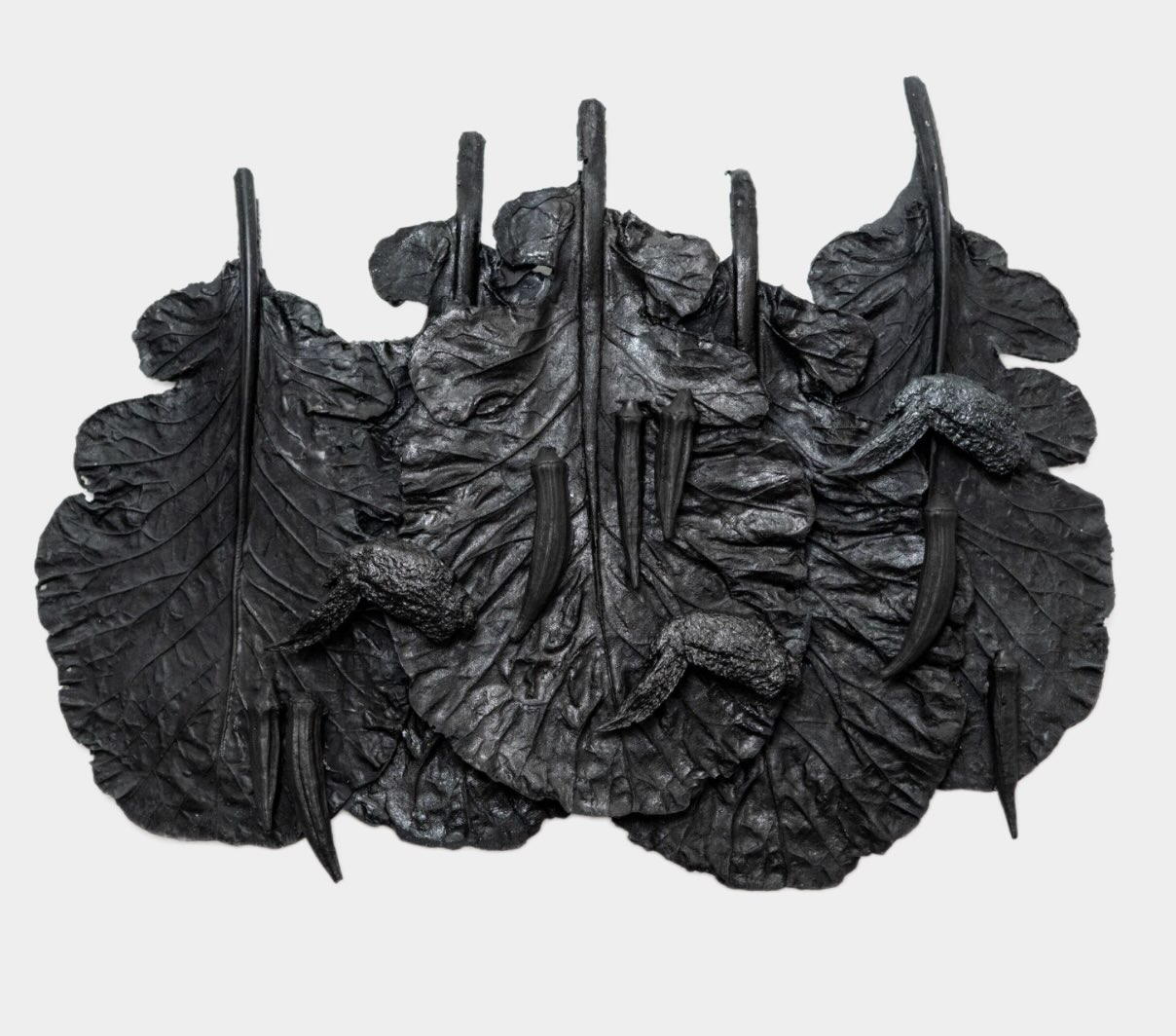
LaKela Brown
LaKela Brown makes plaster reliefs. Door-knocker earrings. Rope chains. Culinary plants and ancestral foods. Objects that carry enormous cultural weight rendered in a material that is simultaneously monumental and fragile, permanent and ghostly.
Her work is in the permanent collections of the Museum of Fine Arts Boston, The Studio Museum in Harlem, and the Mint Museum. The institutional pedigree is serious. But the pedigree isn’t why her work is relevant — it’s confirmation of something the work was already doing on its own.
What Brown is making is a record of how Black American culture understands itself right now — the pride and the inheritance, the insistence on being seen, the line she draws between 1990s hip-hop iconography and West African ethnobotany. The door-knocker earrings aren’t a nostalgic gesture. They’re a statement about what gets passed down, what gets dismissed, and what gets reclaimed. Standing in front of one of her reliefs, you understand something about how Black Americans inhabit their own history that no amount of news coverage could tell you. The work doesn’t document a moment. It records the feeling of living inside one.
That is relevancy at a high level. The signals confirmed it. The signals did not create it.
Maysey Craddock
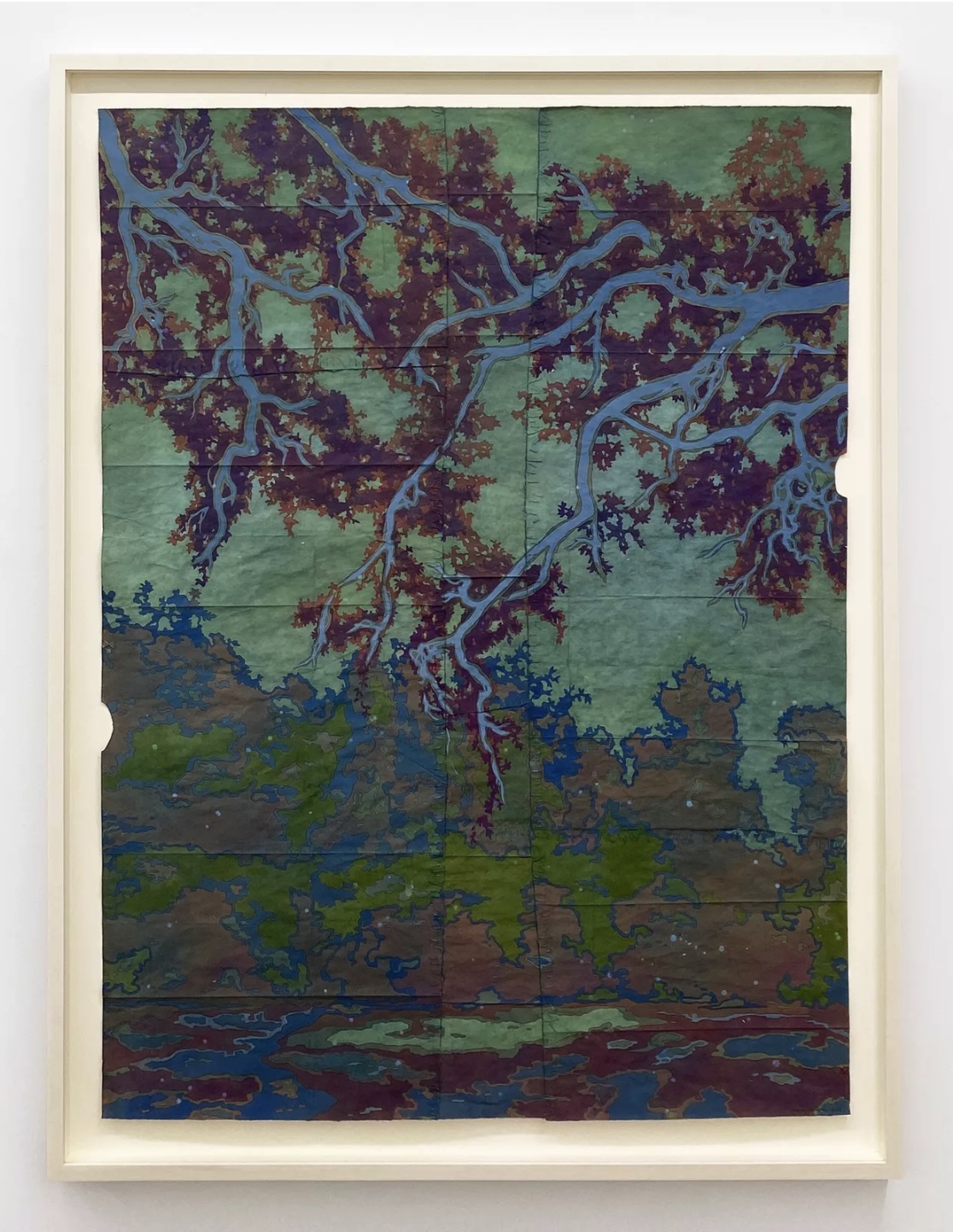
Maysey Craddock works in gouache and thread on found fabric — old grain sacks and worn textiles that have their own history before she ever touches them. Her landscapes are atmospheric and elegiac: marsh grasses, waterways, fragile ecosystems rendered in materials that are themselves evidence of time passing and things wearing out.
Her work isn’t about climate change as a news event. She is not making infographics in paint. What she is making is a record of what it feels like to be a living thing inside a fragile world — the particular quality of attention you develop when you understand that the landscape you’re looking at may not be there in a generation. There is grief in her work, and there is also something that resists grief, some insistence on looking carefully at the beautiful and the precarious and the passing. That combination — the elegy that refuses to stop paying attention — is exactly what it feels like to be an environmentally conscious person alive right now.
Craddock represents what relevancy looks like when there are no obvious signals pointing you toward it. The work isn’t politically loud. It doesn’t announce its urgency. But it is leaving a record of this moment — of what humans in the early twenty-first century understood about their relationship to the natural world and how they felt about what they were losing — that will matter to people looking back on it a hundred years from now.
The Strategic Collector and the Pedigree Trap
If you’ve taken the collector type quiz and discovered you’re a Strategic Collector, relevancy is your natural criterion. You’re wired to seek out work that has something urgent to say — work that is in conversation with the world, that reflects the moment, that will be understood by future historians as meaningful to its time.
And here’s the thing: you’re often right. The signals the Strategic Collector follows — institutional validation, critical attention, major gallery representation — frequently do point toward genuinely relevant work. LaKela Brown is a perfect example. The research and the work arrive at the same place and confirm each other.
But pedigree can confirm relevancy. It cannot replace the act of looking for it. The Strategic Collector’s trap at this criterion isn’t getting the evaluation wrong — it’s outsourcing the evaluation to signals and then mistaking confirmation for discovery. An artist making genuinely urgent work doesn’t need institutional permission to be doing it. The most relevant work often arrives before the apparatus has any idea what to do with it. If you’re only willing to recognize relevancy after someone else has recognized it first, you will always be reading yesterday’s record of how people felt rather than being present for the making of today’s.
The Strategic Collector who trusts their own response to urgency — who is willing to feel the mirror before the museum hangs it — is capable of building something extraordinary.
The Practical Question
When you’re standing in front of anything and trying to evaluate relevancy, the question worth asking is: does this work tell me something true about what it feels like to be alive right now?
Not: is this about something important? Importance is easy to fake. Not: does this reference current events? Events are the surface. The question is whether the work has captured something interior — something about how people actually experience the world they’re in, what they’re afraid of, what they’re reaching for, what they understand about their moment that they couldn’t have understood in any other moment.
You don’t need to be able to articulate it. You just need to feel it. The work that has genuine relevancy tends to produce a specific sensation: the feeling of being seen. Not you personally, necessarily, but the time you’re living in — as if the artist looked directly at this moment and found a way to hold it still long enough to hand it to you.
That’s the test. And when a work passes it, you’ll know — not because someone told you, but because you felt it first.
What The Framework Can't Teach You
There is something the four criteria together point toward that none of them can fully name on their own, and I want to try to say it before we’re done.
The best art is always simultaneously singular and universal. Particular and general. Irreducibly one person’s vision — one set of obsessions, one way of seeing, one life’s worth of specific experience — and somehow, inexplicably, also about everyone.
I felt this in the Picturing Motherhood exhibition at the Cleveland Museum of Art several years ago. It was one of the best topical exhibitions (as in not an exhibition about a specific artist, group of artists, or geographical region) I have ever seen because it hit on the singular and universal aspects of what it means to be a mother. Visitors became immersed in each artist’s unique experience, but also saw themselves in some way in those stories. It was incredibly moving.
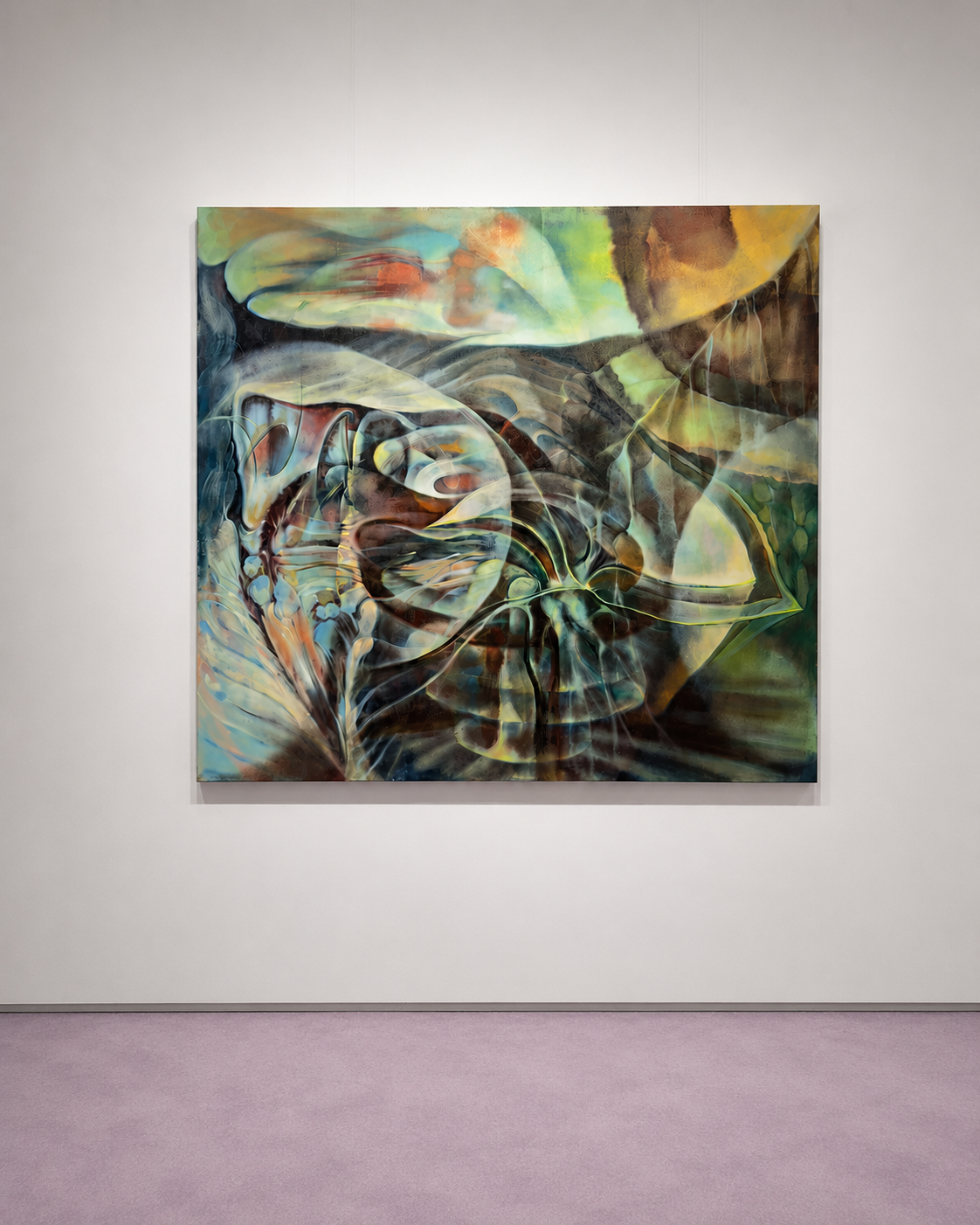
I also experienced this at NADA New York this year, standing in front of the work of Effie Wanyi Li at Foundry Seoul’s booth. Li works in oil on canvas, and her paintings explore what it might look like for energy to course through the body — the inner landscape of sensation and chronic pain rendered in a painterly language that is entirely, unmistakably hers. The work is about something most of us have never tried to see. And standing in front of it I felt it immediately: energy moving through my veins, synapses firing, atoms spinning, the entire hidden universe of activity that has been happening inside my body from the moment of conception and will continue until I take my last breath. It is the most intimate thing about me. I have never once seen it, or even thought about what it really looks like, for that matter. She showed it to me.
That is what the framework is really after. Intentionality tells you the artist is in command of their choices. Novelty tells you they found something nobody else got to first. Self-awareness tells you they know where their work sits in the larger conversation. Relevancy tells you they have something urgent to say about the world we’re actually living in. But underneath all of it is this: the artist made something so precisely, undeniably their own that it had nowhere to go but inward — into you, into everyone who stands in front of it. The particular became universal. The singular became the shared.
You don’t need a framework to feel that. But you need to know how to look for it.
This wraps up the four-part series on how to know if art is good. The complete framework: Intentionality, Novelty, Self-Awareness, Relevancy. Every work in The Collection has passed all four.
Every collector has a type.
A default way of engaging with art — and a default reason they walk away from something they should have bought. Find out yours in two minutes.
Take the Quiz →Already a member? This week's new additions to The Collection are waiting.
Explore The Collection →